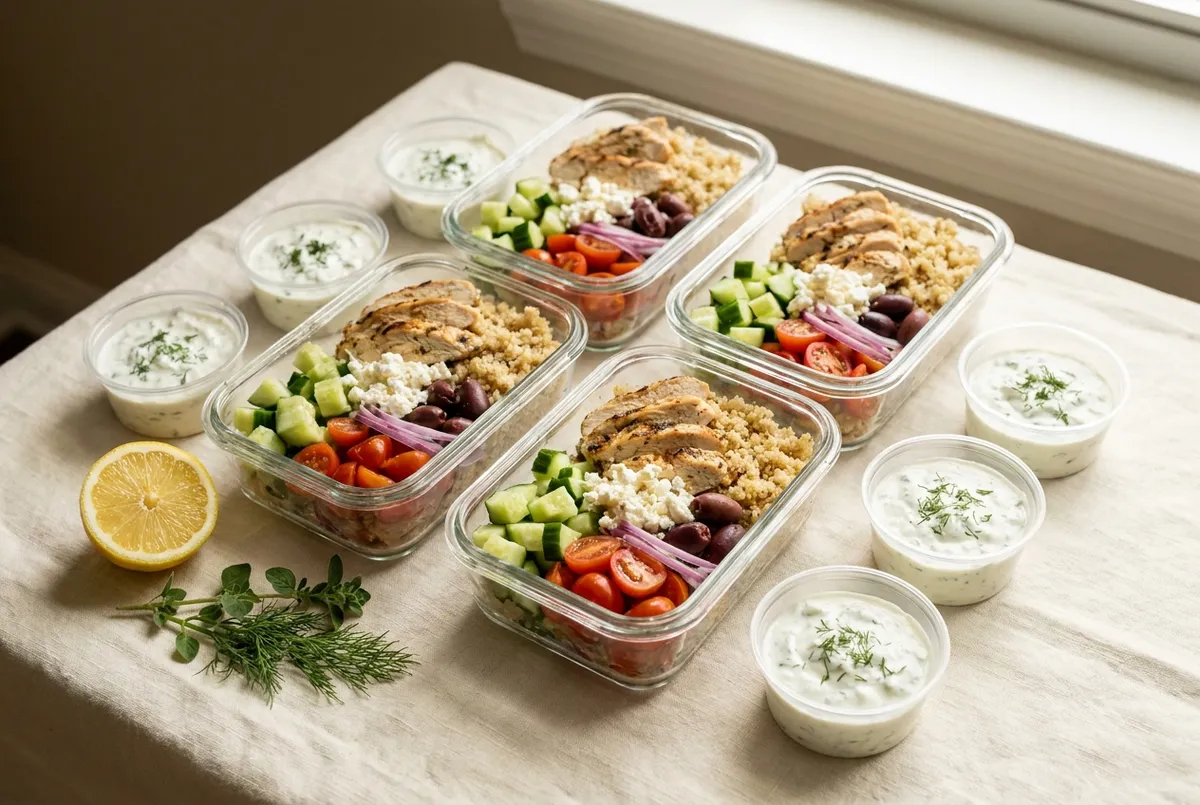
These Greek chicken meal prep bowls turn one hour on Sunday into four lunches you will actually look forward to. Lemon oregano chicken, fluffy quinoa, crisp vegetables, olives, feta, and a thick garlicky tzatziki fill each container. Every bowl carries about 48 grams of protein, so lunch keeps you full until dinner instead of mid-afternoon.
At a glance
- Protein: 48 g per bowl
- Calories: 519 per bowl
- Fiber: 5 g
- Potassium: 1,144 mg
- Total time: 40 minutes, plus marinating
- Makes: 4 bowls
- Good for: 25g+ Protein, Meal Prep, Gluten-Free, Mediterranean
Why Greek chicken meal prep bowls work for women in midlife
Lunch is often the meal that falls apart during a busy week. A granola bar at the desk or a salad with no real protein leaves you hungry by 3 p.m. That gap tends to show up later as snacking and a heavy dinner.
Protein needs rise with age. An international expert group recommends 1.0 to 1.2 grams of protein per kilogram of body weight each day for healthy older adults (source). For most women, that means 70 to 100 grams daily. A 48-gram lunch does a lot of that work in one sitting.
The flavors here come straight from the Mediterranean way of eating. A review of nutrition in menopause points to that pattern, rich in vegetables, legumes, whole grains, olive oil, and lean protein, as supportive of heart and metabolic health (source). These bowls follow it closely.
Calcium gets a small boost too. Each bowl provides about 230 mg from the feta and Greek yogurt. Women over 50 need about 1,200 mg of calcium a day, so every bit helps (source).
What goes into each bowl
Each container holds five parts. They are built to stay fresh for 4 days, which is why the tzatziki travels separately.
- Lemon oregano chicken: about 5 ounces raw per bowl, marinated in olive oil, lemon, garlic, and oregano.
- Quinoa: a quarter cup dry per bowl. Quinoa is one of the few plant foods that contains all nine essential amino acids.
- Crunchy vegetables: diced cucumber, cherry tomatoes, and thin slices of red onion.
- Kalamata olives and feta: the salty, briny notes that make the bowl taste like a taverna plate.
- Tzatziki: Greek yogurt with grated cucumber, garlic, dill, and lemon. It doubles as sauce and as extra protein.
Ingredients and smart swaps
Everything is easy to find at a U.S. supermarket. Full amounts are in the recipe card below.
- Chicken breasts or thighs: breasts keep calories lowest. Thighs are juicier and more forgiving, adding about 60 calories per bowl.
- Quinoa: rinse it before cooking to remove the natural bitter coating. Many brands come pre-rinsed.
- English cucumber: thinner skin and fewer seeds than a regular cucumber. Half is diced for the bowl, half is grated for tzatziki.
- Plain nonfat Greek yogurt: the tzatziki base. 2% yogurt makes a richer sauce.
- Fresh dill: dried dill works at a third of the amount. Fresh mint is a classic swap.
Swaps that keep the bowls working:
- No quinoa? Use brown rice, farro, or orzo. Farro and orzo contain gluten.
- No chicken? Use a can of chickpeas tossed in the same marinade and roasted for 20 minutes. Protein drops to about 25 grams per bowl.
- Dairy-free? Skip the feta and use a thick plain soy or coconut yogurt for the tzatziki.
How to make Greek chicken meal prep bowls
The recipe moves fast when you overlap the steps. Here is how the timing works.
- Marinate the chicken. Whisk olive oil, lemon juice, oregano, garlic, and salt. Toss with the chicken and rest at least 15 minutes, or up to 24 hours in the fridge.
- Start the quinoa. Combine quinoa with 2 cups water and a pinch of salt. Boil, cover, and simmer 15 minutes. Rest 5 minutes, then fluff.
- Cook the chicken. Heat a skillet or grill pan over medium-high. Cook 5 to 7 minutes per side.
- Make the tzatziki. Squeeze the grated cucumber in a towel, then stir into the yogurt with garlic, dill, salt, and lemon.
- Prep the vegetables while the chicken rests: dice cucumber, halve tomatoes, and slice onion.
- Assemble. Divide quinoa, sliced chicken, vegetables, olives, and feta among four containers. Pack the tzatziki separately.
How to cook fluffy quinoa for meal prep
Mushy quinoa turns a good bowl into a soggy one by Wednesday. The fix is the ratio and the rest.
Use 2 cups of water for every cup of dry quinoa. Bring it to a boil, cover, and drop the heat to a gentle simmer for 15 minutes. Then turn off the heat and leave the lid on for 5 more minutes. That rest lets the grains finish absorbing steam without turning to paste.
Fluff with a fork and spread the quinoa on a tray to cool. Packing it while hot traps moisture and makes the grains clump.
For more flavor, cook the quinoa in low-sodium chicken broth, or stir in lemon zest and chopped parsley after fluffing.
A simple Sunday meal prep plan
Here is one way to get all four bowls done in under an hour with little stress.
- Minute 0: mix the marinade and coat the chicken.
- Minute 5: rinse the quinoa and bring it to a boil.
- Minute 10: grate and squeeze the cucumber, then stir together the tzatziki.
- Minute 20: start cooking the chicken while the quinoa rests.
- Minute 35: chop the remaining vegetables as the chicken rests.
- Minute 45: cool, assemble, and refrigerate.
Wash the cutting board and knife after handling raw chicken, before you touch the vegetables.
What temperature should chicken be cooked to?
The USDA safe minimum internal temperature for all poultry is 165°F (source). That rule covers breasts and thighs alike.
An instant-read thermometer is the most reliable test. Insert it into the thickest part of the piece. Without one, cut into the thickest piece and check that the juices run clear and the meat is no longer pink.
Let the chicken rest for 5 minutes before slicing. Resting lets the juices settle back into the meat. Slicing right away sends those juices onto the cutting board and leaves the chicken dry by day 3.
Thighs are harder to overcook than breasts. Many cooks prefer them at 175°F or higher, where the connective tissue softens and the meat turns extra tender.
How to keep meal prep bowls fresh for 4 days
The biggest complaint about meal prep is soggy, tired food by Thursday. A few habits keep these bowls tasting fresh.
Cool everything first. Spread the quinoa and chicken on a tray for 10 minutes before packing. Sealing hot food traps steam, which makes the bowls watery.
Pack the sauce separately. Tzatziki is the wettest part of the bowl. Small lidded cups keep it from soaking into the quinoa.
Squeeze the cucumber. Grated cucumber holds a surprising amount of water. Wringing it out in a towel keeps the tzatziki thick for days.
Use glass containers. Glass does not hold odors, and it lets you see what is inside. Bowls with dividers keep the vegetables crisp and separate from the chicken.
Store within 2 hours. Refrigerate the bowls within 2 hours of cooking. They keep up to 4 days.
Can you eat Greek chicken bowls cold?
Yes, and many people prefer them that way. The bowl is designed like a grain salad, so it tastes good straight from the fridge.
If you like warm chicken and quinoa, remove the vegetables and tzatziki first. Microwave the chicken and quinoa for 60 to 90 seconds, then add the cold toppings back. The contrast of warm grains and cool tzatziki is part of the appeal.
Reheat leftovers until hot all the way through. The USDA recommends 165°F for reheated leftovers (source).
Is the sodium in these bowls too high?
Each bowl carries about 971 mg of sodium. Most of it comes from the feta, olives, and the salt in the marinade. That is a moderate amount for a full meal, but it is worth knowing.
The Dietary Guidelines advise keeping sodium under 2,300 mg a day for most adults (source). One bowl uses a little over 40% of that. If the rest of your day is lower in salt, it fits fine.
To bring it down, try any of these:
- Cut the added salt in the marinade by half. The lemon and garlic carry plenty of flavor.
- Rinse the olives before slicing.
- Use half the feta, or choose a reduced-sodium variety.
Each bowl also provides 1,144 mg of potassium, which helps balance the effects of sodium.
How to make tzatziki that stays thick
Thin, runny tzatziki is usually a cucumber problem. Grated cucumber is mostly water, and that water seeps out as the sauce sits.
Grate the cucumber on the large holes of a box grater. Pile it in the center of a clean kitchen towel, gather the corners, and twist hard over the sink. You will be surprised by how much liquid comes out.
Start with thick Greek yogurt, not regular yogurt. Add the garlic slowly, since raw garlic gets stronger as the sauce rests. A drizzle of olive oil on top before serving adds richness.
Tzatziki keeps 4 days in the fridge. It also works as a dip for raw vegetables, a spread for wraps, or a sauce for the Sheet-Pan Lemon Salmon.
Variations to keep lunches interesting
The same method works with a few new ingredients each week.
- Greek chicken wrap: pile the fillings into a whole-wheat wrap with a spoon of tzatziki.
- Chicken souvlaki salad: swap the quinoa for chopped romaine and add pepperoncini.
- Spiced chicken bowl: add a teaspoon each of cumin and smoked paprika to the marinade, and use hummus instead of tzatziki.
- Vegetarian version: use marinated, roasted chickpeas and cubes of firm tofu instead of chicken.
- Lemon herb salmon: use salmon fillets in the same marinade and roast for 12 minutes at 425°F.
How these bowls fit into your day
A woman who weighs about 150 pounds and aims for 1.0 to 1.2 grams per kilogram needs roughly 68 to 82 grams of protein a day (source). One bowl provides about 48 grams, more than half the upper target.
Older muscle responds best to around 25 to 30 grams of protein at each meal (source). This lunch clears that easily. That leaves room for a lighter dinner or a vegetable-heavy plate.
For breakfast, try the Spinach Feta Cottage Cheese Egg Bites or the Berry Protein Smoothie. The guide on how much protein women need in menopause has a full chart by weight.
Greek Chicken Meal-Prep Bowls with Quinoa & Tzatziki
Ingredients
Method
- Whisk the olive oil, lemon juice, oregano, two-thirds of the garlic, and 3/4 tsp salt. Toss with the chicken and marinate at least 15 minutes (or up to 24 hours in the fridge).
- Cook the quinoa: combine with 2 cups water and a pinch of salt, bring to a boil, cover, and simmer 15 minutes. Rest 5 minutes covered, then fluff.
- Heat a skillet or grill pan over medium-high. Cook the chicken 5–7 minutes per side, until it reaches 165°F (74°C). Rest 5 minutes, then slice.
- Make the tzatziki: squeeze the grated cucumber in a towel to remove excess water, then stir into the Greek yogurt with the remaining garlic, dill, 1/4 tsp salt, and a squeeze of lemon.
- Divide quinoa, chicken, diced cucumber, tomatoes, red onion, olives, and feta among four containers. Pack the tzatziki in small separate containers.
Notes
| Nutrition per serving | Amount |
|---|---|
| Calories | 519 |
| Protein | 48 g |
| Carbohydrates | 39 g |
| Fiber | 5 g |
| Sugars (total) | 5.9 g |
| Fat | 19 g |
| Saturated fat | 4.9 g |
| Sodium | 971 mg |
| Calcium | 230 mg |
| Potassium | 1144 mg |
| Iron | 4.1 mg |
How the nutrition was calculated
Nutrition is calculated per bowl from the gram weight of every ingredient, using USDA FoodData Central data. It is an estimate, since chicken pieces, feta, and olives vary by brand and size. See the editorial and nutrition policy for the full method.
Frequently asked questions
How long do Greek chicken meal prep bowls last?
The bowls keep up to 4 days in airtight containers in the fridge. Store the tzatziki separately so the quinoa and vegetables stay crisp. If you want lunches for the full work week, freeze the cooked chicken for day 5 and thaw it overnight in the fridge before packing that bowl.
Can I freeze these bowls?
The chicken and quinoa freeze well for up to 3 months. The cucumber, tomatoes, onion, and tzatziki do not, because they turn watery after thawing. Freeze the cooked chicken and quinoa together in containers, then add fresh vegetables and sauce after thawing in the fridge overnight.
Can I use chicken thighs instead of breasts?
Yes. Boneless, skinless thighs are juicier and stay tender even when reheated. They add about 60 calories per bowl because of their higher fat. Cook them to at least 165°F. Many cooks take thighs a little higher, since the meat becomes more tender with extra heat.
Is quinoa better than rice for meal prep?
Quinoa holds its texture in the fridge better than white rice, which can turn hard. It also brings more protein and fiber per serving. Brown rice is a fine swap if you prefer it. Cook it fully and cool it quickly before packing to keep it fresh.
What can I use instead of feta?
Goat cheese gives a similar tangy, salty bite. For less sodium, use a few cubes of fresh mozzarella. If you avoid dairy, add extra olives and a sprinkle of toasted pine nuts or sunflower seeds for richness. The bowl will lose a little calcium and protein without the cheese.
Sources
- Bauer J, et al. Evidence-Based Recommendations for Optimal Dietary Protein Intake in Older People (PROT-AGE). J Am Med Dir Assoc. 2013.
- Silva TR, et al. Nutrition in Menopausal Women: A Narrative Review. Nutrients. 2021.
- NIH Office of Dietary Supplements. Calcium: Fact Sheet for Health Professionals.
- USDA Food Safety and Inspection Service. Safe Minimum Internal Temperature Chart.
- U.S. Food and Drug Administration. Sodium in Your Diet.
- Paddon-Jones D, Rasmussen BB. Dietary protein recommendations and the prevention of sarcopenia. Curr Opin Clin Nutr Metab Care. 2009.
- USDA Agricultural Research Service. FoodData Central (SR Legacy).
This article is for general education and is not medical advice. If you have a medical condition, such as kidney disease, or take medication, ask your clinician or a registered dietitian about your protein, sodium, and calorie needs. Read the full medical disclaimer.
Leave a Reply