How much protein do women need in menopause? There is no single protein prescription for everyone going through menopause. The adult recommended dietary allowance (RDA) is 0.8 grams per kilogram of body weight per day. Higher ranges may be appropriate for some people, but needs depend on age, activity, overall intake, and health. The often-quoted 1.0 to 1.2 g/kg range comes from guidance for adults older than 65, not a universal menopause recommendation. Here is how to understand those numbers without turning them into a personal prescription (review of the adult protein RDA; PROT-AGE position paper).
The short answer
- Know the population: PROT-AGE discusses adults older than 65. Do not apply its 1.0 to 1.2 g/kg range automatically to every woman aged 40 to 60 (PROT-AGE position paper).
- Think in meals, not rigid thresholds: include a protein source at meals. Twenty-five to thirty grams can be a planning example, not a requirement or absorption limit for everyone.
- Partners: protein works best alongside strength training, enough calcium, and plenty of fiber.
For illustration, 150 pounds is about 68 kilograms. Multiplying by 0.8 gives about 54 grams; multiplying by 1.0 and 1.2 gives about 68 and 82 grams. These are different reference calculations, not a choice this page can make for your health.
Why protein needs change in midlife
Muscle mass and strength decline naturally with age. The process often speeds up around menopause, as estrogen levels fall. Less muscle is linked to a slower metabolism, weaker bones, and a higher risk of falls later in life.
Protein supplies the amino acids the body uses to maintain and rebuild muscle. Older muscle appears to need a larger dose of protein at one time to respond fully. Researchers sometimes call this anabolic resistance. In practice, it means a small amount of protein at breakfast does less than it used to (source).
Bone health is the second reason. An international expert consensus concluded that adequate protein, together with enough calcium and vitamin D, supports bone health. The same review found that higher protein intakes do not harm bones in healthy people (source).
A narrative review of nutrition in menopausal women also places quality protein at the center of a healthy eating pattern, alongside whole grains, vegetables, legumes, and healthy fats (source).
How much protein do women need in menopause per day?
The adult RDA is an average daily intake intended to meet the nutrient requirements of nearly all healthy adults. It is not simply a deficiency threshold, a maximum, or a personalized goal. Whether someone benefits from a higher intake is a separate question (review of the adult protein RDA).
The PROT-AGE group recommends at least 1.0 to 1.2 grams per kilogram daily for adults older than 65 to help maintain or regain lean mass and function. Its discussion of higher intakes in illness concerns that older population and requires clinical context. This is not evidence that menopause alone requires everyone to increase to that range (PROT-AGE position paper).
| Body weight | Example at 1.0 g/kg | Example at 1.2 g/kg | Arithmetic split into 3 meals |
|---|---|---|---|
| 130 lb (59 kg) | 59 g | 71 g | 20 to 24 g |
| 150 lb (68 kg) | 68 g | 82 g | 23 to 27 g |
| 170 lb (77 kg) | 77 g | 92 g | 26 to 31 g |
| 190 lb (86 kg) | 86 g | 103 g | 29 to 34 g |
| 210 lb (95 kg) | 95 g | 114 g | 32 to 38 g |
How to understand a protein calculation
You can find your number in three quick steps.
- Convert pounds to kilograms. Divide your weight in pounds by 2.2. A 160-pound woman weighs about 73 kilograms.
- Multiply by 1.0 and 1.2. For 73 kilograms, that gives a range of 73 to 88 grams of protein per day.
- Divide by your meals. Across three meals, that is about 24 to 29 grams per meal. A snack can cover the rest.
Do not select a target simply because you are active, smaller, losing weight, or recovering from illness. Those details can affect an assessment, but a clinician or registered dietitian should interpret them alongside your overall diet and medical history. Kidney disease can change both the amount and the sources of protein that are appropriate (NIDDK kidney nutrition guidance).
If your weight is well above a healthy range, using your current weight may overestimate your needs. A registered dietitian can calculate a target from an adjusted weight instead.
Why per-meal protein matters
A typical American day is low in protein at breakfast, moderate at lunch, and heavy at dinner. A bowl of cereal might carry 6 grams. Dinner might carry 45.
Some muscle-protein research discusses meals containing about 25 to 30 grams of high-quality protein. Results depend on age, exercise, body size, study design, and the food eaten. A short-term muscle response is not proof of one ideal meal target for every woman in menopause. PROT-AGE itself notes that evidence on timing is not sufficient for specific recommendations (PROT-AGE position paper).
If breakfast is mainly toast or cereal, adding yogurt, eggs, tofu, or another food you enjoy is one practical option. Check what you actually eat before assuming there is a gap. You do not need to move a fixed number of grams from dinner or hit the same number at every meal.
What 25 to 30 grams of protein looks like
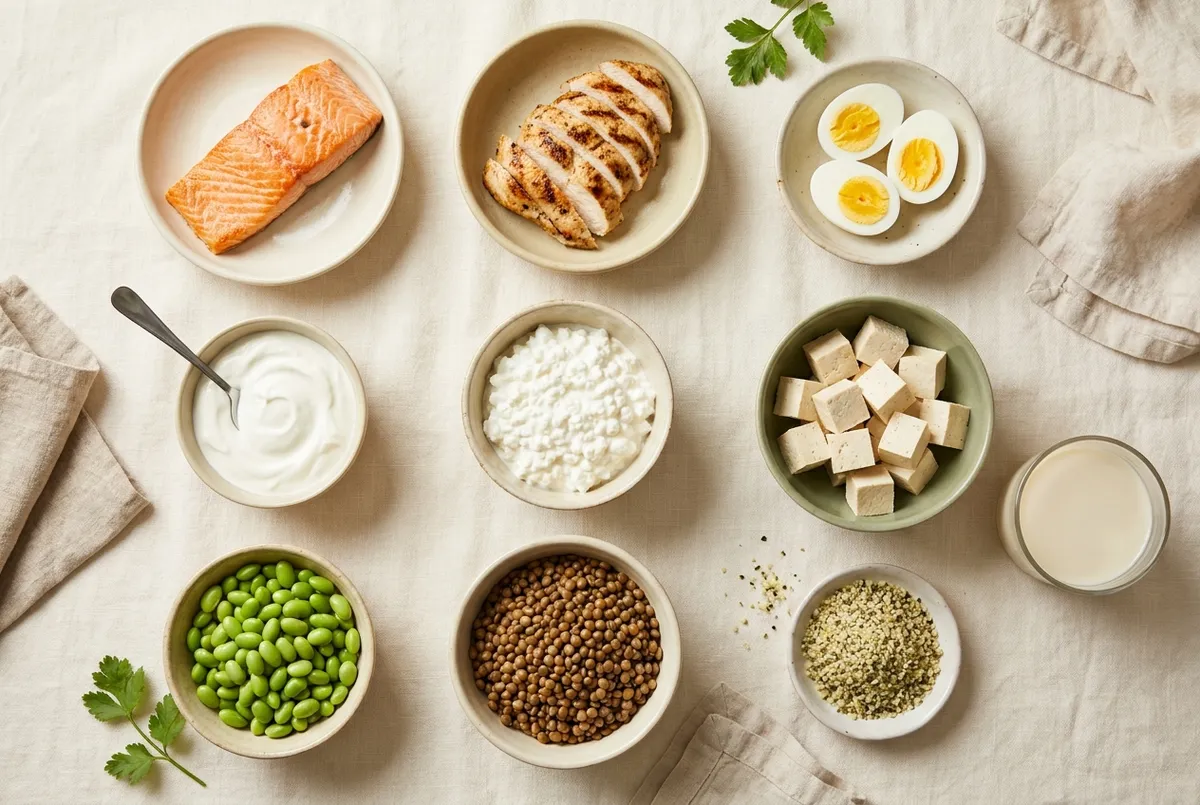
Many women are surprised by how much food it takes to reach 25 grams. The table below shows common sources.
| Food | Portion | Protein (approx.) |
|---|---|---|
| Chicken breast, cooked | 4 oz (113 g) | 35 g |
| Salmon, cooked | 4 oz (113 g) | 25 g |
| Plain nonfat Greek yogurt | 3/4 cup (170 g) | 17 g |
| 2% cottage cheese | 1/2 cup (113 g) | 12 g |
| Eggs | 2 large | 13 g |
| Extra-firm tofu | 1/4 block (100 g) | 10 g |
| Lentils, cooked | 1/2 cup (99 g) | 9 g |
| Edamame, shelled | 1/2 cup (75 g) | 8 g |
| Soy milk, unsweetened | 1 cup (243 g) | 7 g |
| Hemp hearts | 2 Tbsp (20 g) | 6 g |
The easiest meals combine two or three of these foods. Eggs plus cottage cheese, or Greek yogurt plus soy milk and seeds, get you to 25 grams without much effort.
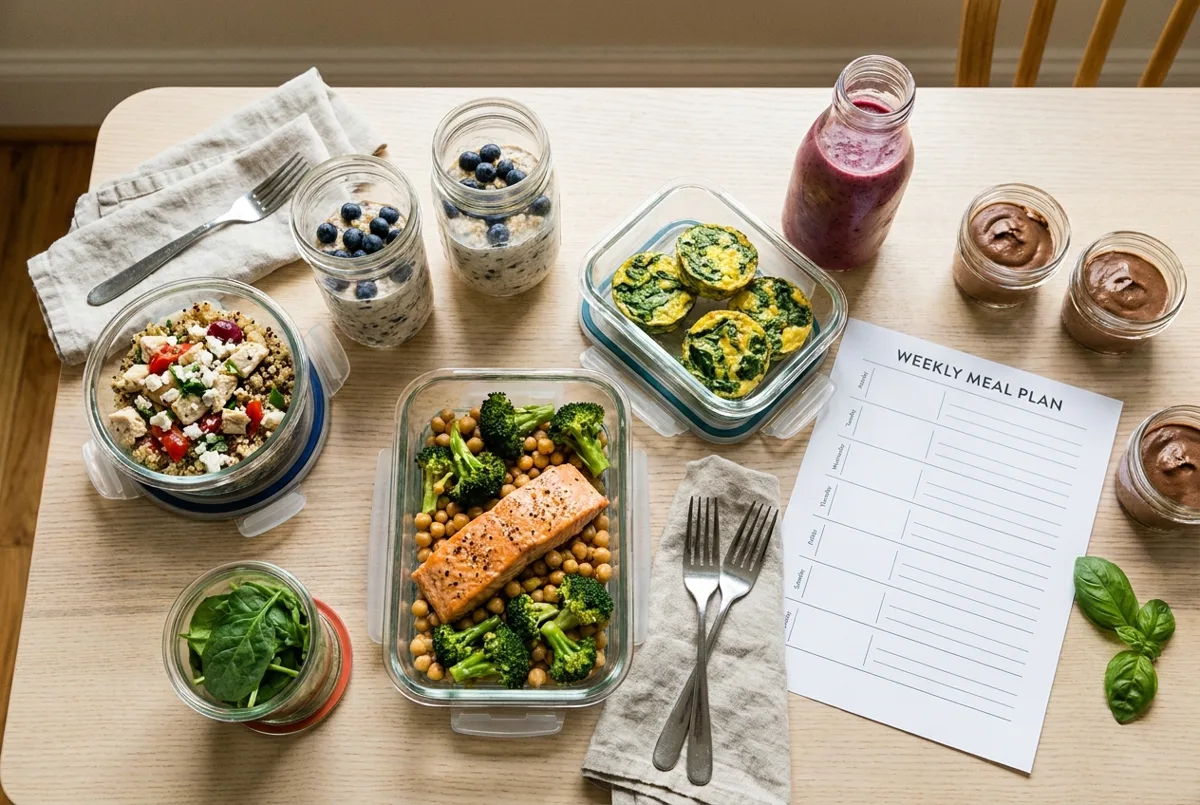
These recipes were built around that goal, each with full nutrition:
- Spinach Feta Cottage Cheese Egg Bites: 27 g
- High-Protein Overnight Oats: 30 g
- Berry Protein Smoothie, no powder: 25 g
- Greek Chicken Meal-Prep Bowls: 48 g
- Sheet-Pan Lemon Salmon with Chickpeas: 39 g
- Peanut Tofu Soba Bowls: 26 g
- Chocolate Cottage Cheese Mousse: 19 g
A sample high-protein day
Here is an illustrative combination totaling about 102 to 112 grams using the rounded figures below. It is not a prescribed intake for menopause.
| Meal | Recipe | Protein |
|---|---|---|
| Breakfast | High-Protein Overnight Oats | 30 g |
| Lunch | Greek Chicken Meal-Prep Bowl | 48 g |
| Snack | Chocolate Cottage Cheese Mousse | 19 g |
| Dinner | Vegetables and whole grains with a small portion of fish or beans | 5 to 15 g |
The table adds up to approximately 102 to 112 grams of protein using the rounded values shown. The dinner is only a broad illustration, not a nutritionally calculated recipe. This is a meal-combination example, not a daily target or a complete calorie, fiber, or micronutrient plan. Portions can be adapted with professional guidance when needed.
Egg bites, a tofu soba bowl, and salmon offer another combination of published recipes. Their nutrition estimates describe those recipes, not what a person of a particular body weight should eat. Other foods, portions, hunger, and individual needs still matter.
Animal and plant protein: which is better?
Both work. The best choice is the one you will eat consistently.
Animal proteins such as eggs, dairy, fish, and poultry are complete proteins. They supply all nine essential amino acids in one food and tend to be protein-dense.
Plant proteins come packaged with fiber and other helpful nutrients. Soy foods such as tofu, tempeh, edamame, and soy milk are complete proteins too. Beans, lentils, whole grains, nuts, and seeds fill the gaps when eaten across the day.
You can include a variety of protein foods on a vegetarian or mostly plant-based diet. It simply takes a little more planning, because plant foods often carry less protein per bite. Combining soy, legumes, and dairy or eggs makes it easy.
Does soy help with menopause symptoms?
Soy contains isoflavones, plant compounds with a weak estrogen-like effect. That has made soy a popular topic for hot flashes.
A meta-analysis found that soy isoflavone supplements modestly reduced hot flash frequency and severity (source). However, The Menopause Society’s 2023 position statement on nonhormone therapy does not recommend soy for hot flashes, because the evidence across studies is inconsistent (source).
The practical advice is simple. Eat soy foods because they are nutritious and affordable sources of protein. Do not rely on them to treat symptoms. If hot flashes disrupt your life, a clinician can discuss options with stronger evidence.
Protein, weight, and menopause belly fat
No food targets belly fat directly. Fat loss happens across the body, not in one chosen area.
What protein can do is make weight management easier. Protein-rich meals tend to be more filling. When you eat a little less to lose weight, enough protein also helps protect muscle, so more of the weight lost comes from fat.
That matters because muscle loss can make later weight gain easier. Keeping protein steady, lifting weights two or three times a week, and sleeping well are the foundation. None of them is dramatic, but together they work.
Strength training and protein work together
Protein alone does not build muscle. It gives the body raw materials, and exercise tells the body to use them.
Resistance training, such as lifting weights, using bands, or bodyweight moves like squats and push-ups, is the strongest signal for muscle growth at any age. Pairing it with enough protein produces better results than either one alone (source).
You do not need a gym to begin strength-focused activity, but the right exercises and progression depend on your ability and health. The British Dietetic Association menopause guide discusses muscle-strengthening exercise alongside a balanced diet. Seek individual advice if you have pain, osteoporosis, balance problems, or another condition that affects exercise.
Do you need protein powder?
No. Powders are convenient, but whole foods provide protein along with calcium, fiber, and other nutrients that powders often lack.
If you choose a powder, look for one with third-party testing, such as NSF Certified for Sport or Informed Choice. Supplements are not approved by the FDA before sale, so independent testing is the best way to know what is inside.
A powder can help on busy days, while traveling, or when appetite is low. It works best as a backup rather than the base of your diet.
Calcium, vitamin D, and fiber: protein’s partners
Protein supports bones best when calcium and vitamin D are adequate too (source). Women over 50 need about 1,200 mg of calcium a day (source).
Dairy foods such as Greek yogurt and cottage cheese supply both protein and calcium. Fortified soy milk and tofu made with calcium sulfate do the same for plant-based eaters.
Fiber matters as well. The Dietary Guidelines suggest about 22 to 25 grams of fiber a day for adult women (source). High-protein diets built only on meat can fall short on fiber. Adding beans, lentils, oats, berries, and vegetables keeps the balance right.
A simple high-protein grocery list
Keeping a few staples on hand makes 25-gram meals almost automatic.
- Dairy and eggs: plain Greek yogurt, cottage cheese, eggs, liquid egg whites, milk or soy milk.
- Fish and poultry: salmon fillets, canned tuna or salmon, boneless chicken breasts or thighs.
- Plant proteins: extra-firm tofu, frozen edamame, canned chickpeas and lentils, tempeh.
- Seeds and nuts: hemp hearts, chia seeds, ground flaxseed, peanut butter, almonds.
- Grains: rolled oats, quinoa, whole-grain bread, buckwheat soba noodles.
Who should be careful with higher protein?
People with chronic kidney disease, and anyone told by a clinician to limit protein, should follow individual advice (source). Higher protein is not right for everyone.
If you have a medical condition or take medication, check with your doctor or a registered dietitian before making big changes to your diet.
Frequently asked questions
Is 100 grams of protein a day too much for a woman over 50?
One hundred grams is not automatically necessary or appropriate because someone is over 50. At 180 pounds, the arithmetic range of 1.0 to 1.2 g/kg is about 82 to 98 grams, and that older-adult reference is not a prescription for all women in midlife. Ask a clinician or dietitian about your situation rather than using this example as a safety guarantee.
What is the easiest way to add protein at breakfast?
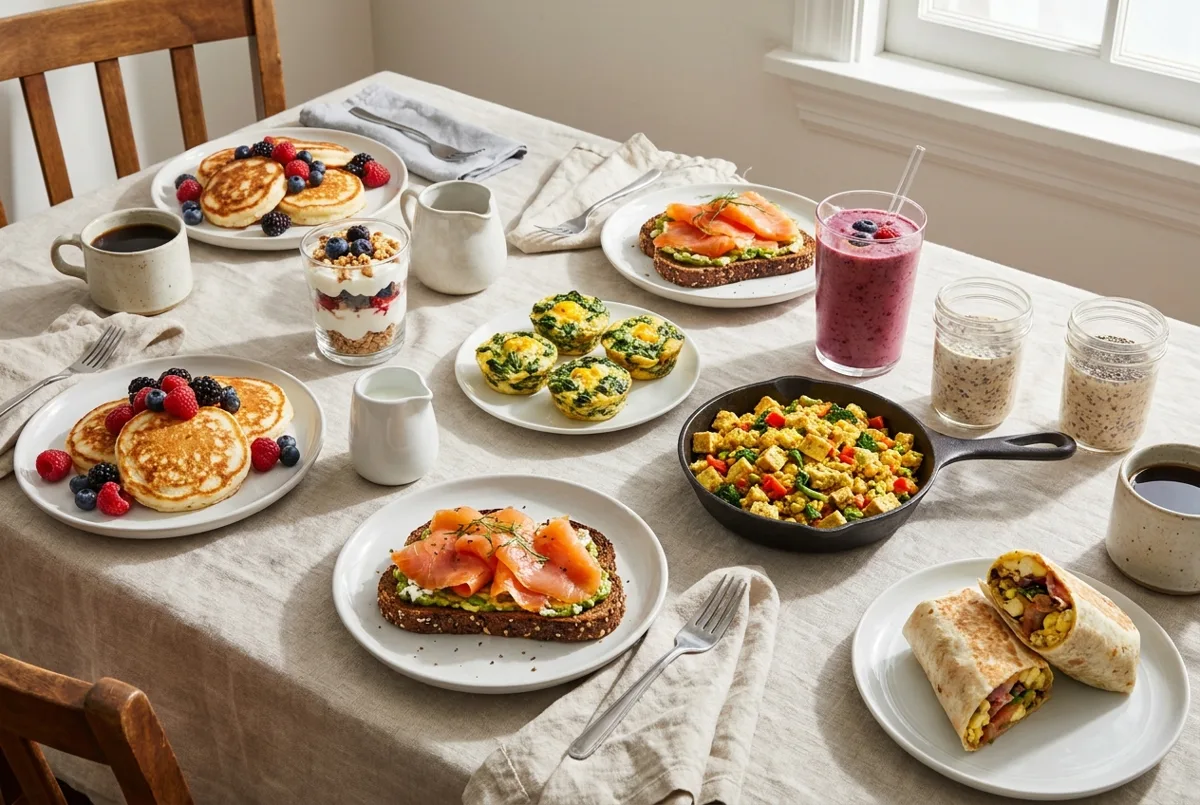
Start with Greek yogurt, cottage cheese, or eggs. Each one gets you most of the way to 25 grams in a single serving. The egg bites and overnight oats are built around exactly this idea, and both can be made days ahead.
Can you eat too much protein at one meal?
Protein in a larger meal is not simply wasted, and there is no universal 25- or 30-gram absorption limit. Total intake, food pattern, age, activity, and health all matter. Use a comfortable meal pattern rather than treating a proposed muscle-response range as a hard limit (PROT-AGE position paper).
Does protein help with hot flashes?
There is no strong evidence that protein itself reduces hot flashes. Protein supports muscle, bone, and fullness, which all matter in menopause. For hot flashes, talk with a clinician about proven treatments. Soy has been studied, but the evidence is inconsistent, and major guidelines do not recommend it for symptoms.
Should I count protein every day?
Most women do not need to track daily. Tracking for a week can show you where the gaps are, often at breakfast. After that, simple habits work well: a palm-sized protein portion at each meal, or a recipe with a protein source, can simplify planning without an app.
Sources
- Bauer J, et al. Evidence-Based Recommendations for Optimal Dietary Protein Intake in Older People (PROT-AGE). J Am Med Dir Assoc. 2013.
- Paddon-Jones D, Rasmussen BB. Dietary protein recommendations and the prevention of sarcopenia. Curr Opin Clin Nutr Metab Care. 2009.
- Rizzoli R, et al. Benefits and safety of dietary protein for bone health (ESCEO/IOF expert consensus). Osteoporos Int. 2018.
- Silva TR, et al. Nutrition in Menopausal Women: A Narrative Review. Nutrients. 2021.
- Taku K, et al. Extracted or synthesized soybean isoflavones reduce menopausal hot flash frequency and severity. Menopause. 2012.
- The 2023 Nonhormone Therapy Position Statement of The North American Menopause Society. Menopause. 2023.
- NIH Office of Dietary Supplements. Calcium: Fact Sheet for Health Professionals.
- U.S. Departments of Agriculture and Health and Human Services. Dietary Guidelines for Americans, 2020 to 2025.
- USDA Agricultural Research Service. FoodData Central (SR Legacy).
This article is for general education and is not medical advice. If you have a medical condition, such as kidney disease, or take medication, ask your clinician or a registered dietitian about your protein, sodium, and calorie needs. Read the full medical disclaimer.
Leave a Reply