This protein smoothie without protein powder gets 25 grams of protein from foods you already buy: Greek yogurt, soy milk, and hemp hearts. Frozen berries and half a banana make it thick and naturally sweet, with no added sugar. It takes five minutes, delivers 8 grams of fiber, and tastes like a berry milkshake, not a chalky shake.
At a glance
- Protein: 25 g per smoothie
- Calories: 340
- Fiber: 8 g
- Calcium: 505 mg
- Total time: 5 minutes
- Makes: 1 large smoothie
- Good for: 25g+ Protein, No-Cook, Vegetarian, Gluten-Free, High Fiber
Why make a protein smoothie without protein powder?
Protein powder is convenient, but it is not required. Many women in midlife are looking for simpler options, with shorter ingredient lists and fewer supplements in the cupboard.
Powders also vary widely in quality. Supplements are not approved by the FDA before they are sold, so the label is the main assurance of what is inside. Whole foods skip that question entirely.
Whole foods also bring more than protein. The yogurt and fortified soy milk in this smoothie supply about 505 mg of calcium. That is roughly 42% of the 1,200 mg recommended daily for women over 50 (source). Most powders offer little calcium unless it is added.
Then there is fiber. Berries, flax, and hemp give this smoothie 8 grams. The Dietary Guidelines suggest about 22 to 25 grams a day for adult women, and most fall short (source).
Where the 25 grams of protein comes from
The total comes from three everyday ingredients working together.
| Ingredient | Amount | Protein (approx.) |
|---|---|---|
| Plain nonfat Greek yogurt | 1/2 cup | 12 g |
| Unsweetened soy milk | 1 cup | 7 g |
| Hemp hearts | 1 Tbsp | 3 g |
| Ground flaxseed | 1 Tbsp | 1.5 g |
| Berries, banana, spinach | as listed | 1.5 g |
Soy milk is the quiet hero. It carries about 7 grams of protein per cup, compared with about 1 gram in most almond milks. Switching milks is the easiest way to add protein to any smoothie.
Why protein at breakfast matters after 40
Many women eat most of their daily protein at dinner and very little in the morning. Research on aging muscle suggests that spreading protein evenly works better. About 25 to 30 grams per meal appears to be the amount older muscle needs to respond fully (source).
Daily needs rise too. An international expert group recommends 1.0 to 1.2 grams of protein per kilogram of body weight for healthy older adults (source). For a 150-pound woman, that is about 68 to 82 grams a day.
A breakfast smoothie with 25 grams gets you a third of the way there before the day begins. That is hard to match with toast, cereal, or a typical fruit smoothie, which often lands under 5 grams.
Ingredients and smart swaps
Everything here is easy to find. Full amounts are in the recipe card below.
- Unsweetened soy milk: the best plant milk for protein. Cow’s milk works almost as well, with about 8 grams per cup.
- Plain nonfat Greek yogurt: thick, tangy, and protein-rich. Icelandic skyr is a good swap.
- Frozen mixed berries: strawberries, blueberries, raspberries, or a blend. Frozen fruit makes the smoothie cold and thick without ice.
- Half a frozen banana: adds sweetness and body. Peel and slice ripe bananas before freezing.
- Hemp hearts: soft, nutty seeds with protein and healthy fats. They blend in completely.
- Ground flaxseed: adds fiber and plant omega-3 fat.
- Baby spinach: optional. A handful disappears into the berry color.
Swaps that keep the smoothie working:
- No hemp hearts? Use a tablespoon of peanut butter or almond butter.
- No banana? Use half a cup of frozen mango or a few frozen cauliflower florets for creaminess.
- Dairy-free? Swap the Greek yogurt for silken tofu or a thick soy yogurt. Silken tofu adds about 4 grams of protein per 1/4 cup.
How to make a thick, smooth berry smoothie
The order you load the blender matters more than most people think.
- Liquids first. Pour in the soy milk and add the Greek yogurt. Liquid at the bottom helps the blades spin freely.
- Soft ingredients next. Add spinach, hemp hearts, and flax.
- Frozen fruit last. Add the banana and berries on top. Their weight pushes everything down into the blades.
- Blend on high for 45 to 60 seconds, until completely smooth.
- Adjust. Add a splash of milk if it is too thick, or a few more frozen berries if it is too thin.
Serve it right away. Smoothies separate as they sit, and the flax keeps thickening the longer it waits.
Is this smoothie good for menopause?
No single drink treats menopause symptoms. What this smoothie does well is cover several nutrients that matter more in midlife, all in one glass.
Protein helps protect muscle, which declines faster around menopause. Calcium supports bone health, which also becomes a concern as estrogen falls. Fiber helps with fullness and supports healthy cholesterol levels.
A review of nutrition in menopausal women highlights fruit, vegetables, legumes, and quality protein as key parts of a supportive eating pattern (source). Berries, soy, seeds, and yogurt in one glass make that easy.
The smoothie also provides about 1,181 mg of potassium, which helps balance the effects of sodium on blood pressure.
How much sugar is in this smoothie?
Each smoothie contains about 18 grams of total sugar, but none of it is added sugar. The sugar comes from berries, banana, and the natural lactose in yogurt.
That difference matters. Fruit sugar comes packaged with fiber, water, and nutrients. Added sugar from syrups or sweetened yogurts brings calories without much else. The American Heart Association suggests women keep added sugar to about 6 teaspoons a day (source).
Many café smoothies are made with juice, sherbet, or sweetened yogurt. They can carry several times this amount of sugar, with far less protein. Making your own puts you in control.
Is this a good smoothie after a workout?
Yes. Strength training is one of the best habits for protecting muscle in midlife, and protein helps the body repair after a session. Research on aging muscle suggests a meal with 25 to 30 grams of quality protein supports that process (source).
This smoothie lands right in that range. It also brings carbohydrates from fruit, which help refill energy stores after exercise.
There is no need to rush to drink it within minutes. Getting a protein-rich meal or snack within a few hours of training is a reasonable goal for most people. If you train in the morning, this smoothie can double as breakfast.
How this compares with a typical fruit smoothie
A homemade protein smoothie and a café fruit smoothie can look the same in the glass. The nutrition is very different.
| Feature | This smoothie | Typical fruit and juice smoothie |
|---|---|---|
| Protein source | Greek yogurt, soy milk, hemp | Little or none |
| Liquid base | Unsweetened soy milk | Fruit juice |
| Added sugar | None | Often syrups or sweetened yogurt |
| Fiber | About 8 g | Often low |
| Keeps you full | Usually until lunch | Often under 2 hours |
Common smoothie mistakes
Using juice as the base. Juice adds sugar without fiber or protein. Milk or soy milk gives you both creaminess and protein.
Too much fruit. More fruit means more sugar and a thinner drink. About 1 1/2 cups of fruit total is plenty.
Skipping the fat. A little fat from seeds or nut butter helps you stay full and helps your body absorb some vitamins.
Adding ice instead of frozen fruit. Ice waters down the flavor. Frozen fruit chills and thickens at the same time.
Forgetting the salt and spice. A tiny pinch of salt or cinnamon makes berries taste sweeter and rounder. It costs nothing and changes the whole drink.
How to prep smoothies for the week
Smoothie packs make busy mornings faster. Here is how to set them up.
Fill freezer bags with the berries, banana, spinach, hemp hearts, and flax for each smoothie. Label and lay them flat in the freezer. They keep about 3 months.
In the morning, pour the soy milk and yogurt into the blender, add one frozen pack, and blend. The whole process takes about 2 minutes.
Some people blend smoothies the night before. That works, but the texture suffers. Flax and chia keep absorbing liquid and turn the smoothie thick and gloppy. If you must blend ahead, store it in a sealed jar and shake well before drinking.
Blender tips for the smoothest texture
A powerful blender helps, but any blender can make a great smoothie with the right habits.
Let frozen fruit soften for a minute. Rock-hard fruit strains small motors. A brief rest on the counter helps.
Start low, then go high. Begin on a low speed to break up the frozen pieces, then switch to high.
Use the tamper or pause to stir. If the blades spin in an air pocket, stop and push the ingredients down with a spoon.
Add liquid slowly. It is easy to thin a thick smoothie and hard to thicken a thin one.
Flavor variations to try
Keep the soy milk, Greek yogurt, and seeds, and change the fruit and flavor.
- Chocolate cherry: frozen dark cherries plus a tablespoon of unsweetened cocoa powder.
- Peanut butter banana: a whole frozen banana, a tablespoon of peanut butter, and cinnamon. Skip the berries.
- Green tropical: frozen mango and pineapple with a big handful of spinach.
- Strawberry vanilla: frozen strawberries and a drop of vanilla extract.
- Coffee mocha: a shot of cooled espresso, cocoa powder, and half a frozen banana.
How this smoothie fits into your day
A woman who weighs about 150 pounds and aims for 1.0 to 1.2 grams per kilogram needs roughly 68 to 82 grams of protein a day (source). One smoothie provides about 25 grams, close to a third of the lower target.
Follow it with the Greek Chicken Meal-Prep Bowls at lunch and the Sheet-Pan Lemon Salmon at dinner. On cooler mornings, the High-Protein Overnight Oats bring 30 grams in a jar.
The guide on how much protein women need in menopause has a full chart by body weight.
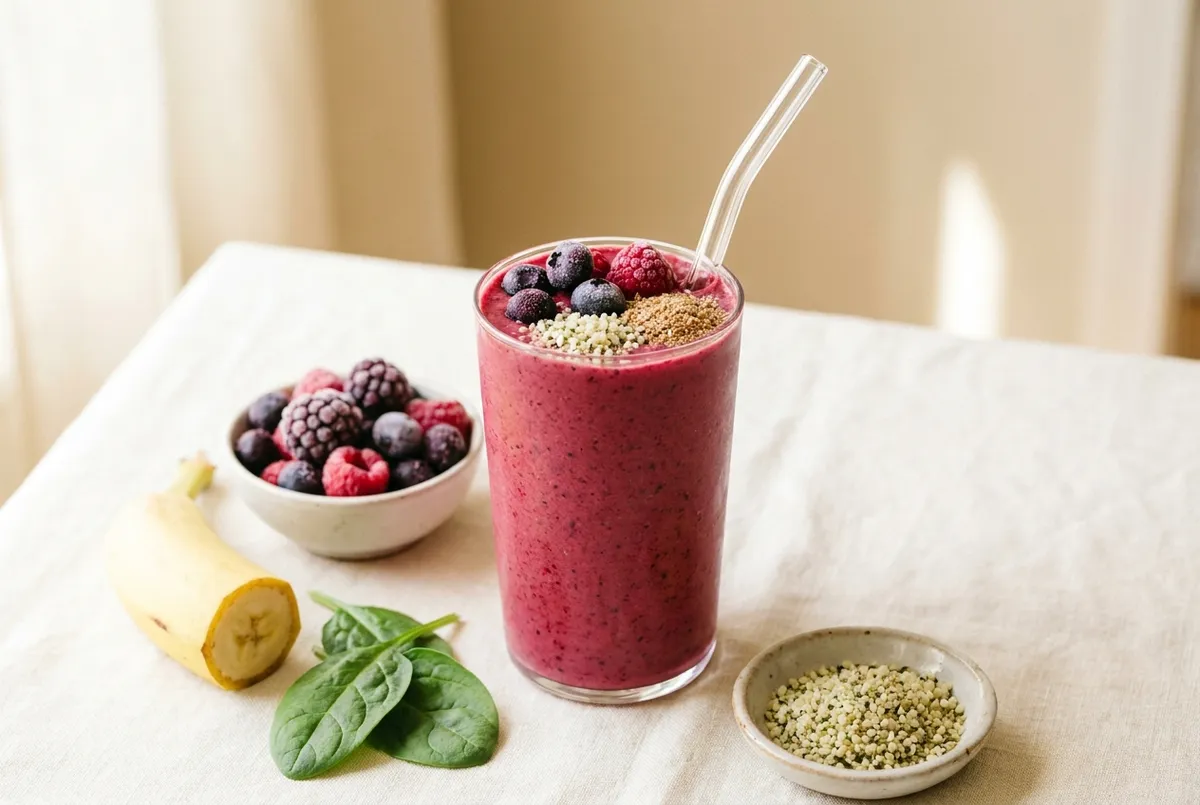
Berry Protein Smoothie (No Protein Powder)
Ingredients
Method
- Add the soy milk and Greek yogurt to the blender first (liquids first helps it blend smoothly).
- Add the spinach, hemp hearts, flaxseed, banana, and frozen berries.
- Blend on high for 45–60 seconds, until completely smooth. Add a splash more milk if needed. Serve immediately.
Notes
| Nutrition per serving | Amount |
|---|---|
| Calories | 340 |
| Protein | 25 g |
| Carbohydrates | 36 g |
| Fiber | 8.4 g |
| Sugars (total) | 18 g |
| Fat | 13 g |
| Saturated fat | 1.4 g |
| Sodium | 160 mg |
| Calcium | 505 mg |
| Potassium | 1181 mg |
| Iron | 4.4 mg |
How the nutrition was calculated
Nutrition is calculated per smoothie from the gram weight of each ingredient, using USDA FoodData Central data. It is an estimate, since yogurt and soy milk brands differ in protein, calcium, and vitamin D. See the editorial and nutrition policy for the full method.
Frequently asked questions
Can I make this smoothie without yogurt?
Yes. Replace the Greek yogurt with 1/2 cup of silken tofu, or a thick plain soy yogurt. Silken tofu blends completely smooth and adds protein with a neutral taste. The smoothie will lose some calcium and tang, so a squeeze of lemon juice helps brighten the flavor without changing the protein much.
What is the best milk for a protein smoothie?
Unsweetened soy milk and cow’s milk are the best choices for protein, each with about 7 to 8 grams per cup. Pea protein milk is another high-protein option. Almond, oat, and coconut milks are lower in protein, usually 1 to 3 grams per cup. Check that plant milks are fortified with calcium.
Can I use fresh fruit instead of frozen?
Fresh fruit works, but the smoothie will be thinner and warmer. Add a handful of ice cubes to make up for it, or freeze your fresh berries for an hour before blending. Frozen fruit is often cheaper than fresh, keeps for months, and gives the thickest, creamiest result.
Are hemp hearts safe to eat?
Hemp hearts are the hulled seeds of the hemp plant, sold as a regular grocery food. The FDA has reviewed hulled hemp seeds for use in foods and raised no safety questions. They contain only trace amounts of THC and are rich in protein and healthy fats. People with seed allergies should check with their clinician before trying them.
Is this smoothie filling enough for breakfast?
For most people, yes. With 25 grams of protein, 8 grams of fiber, and about 340 calories, it is a real meal. If you are very active or find you get hungry early, add a slice of whole-grain toast with peanut butter, or a hard-boiled egg on the side.
Sources
- NIH Office of Dietary Supplements. Calcium: Fact Sheet for Health Professionals.
- U.S. Departments of Agriculture and Health and Human Services. Dietary Guidelines for Americans, 2020 to 2025.
- Paddon-Jones D, Rasmussen BB. Dietary protein recommendations and the prevention of sarcopenia. Curr Opin Clin Nutr Metab Care. 2009.
- Bauer J, et al. Evidence-Based Recommendations for Optimal Dietary Protein Intake in Older People (PROT-AGE). J Am Med Dir Assoc. 2013.
- Silva TR, et al. Nutrition in Menopausal Women: A Narrative Review. Nutrients. 2021.
- American Heart Association. Added Sugars.
- USDA Agricultural Research Service. FoodData Central (SR Legacy).
This article is for general education and is not medical advice. If you have a medical condition, such as kidney disease, or take medication, ask your clinician or a registered dietitian about your protein, sodium, and calorie needs. Read the full medical disclaimer.
Leave a Reply