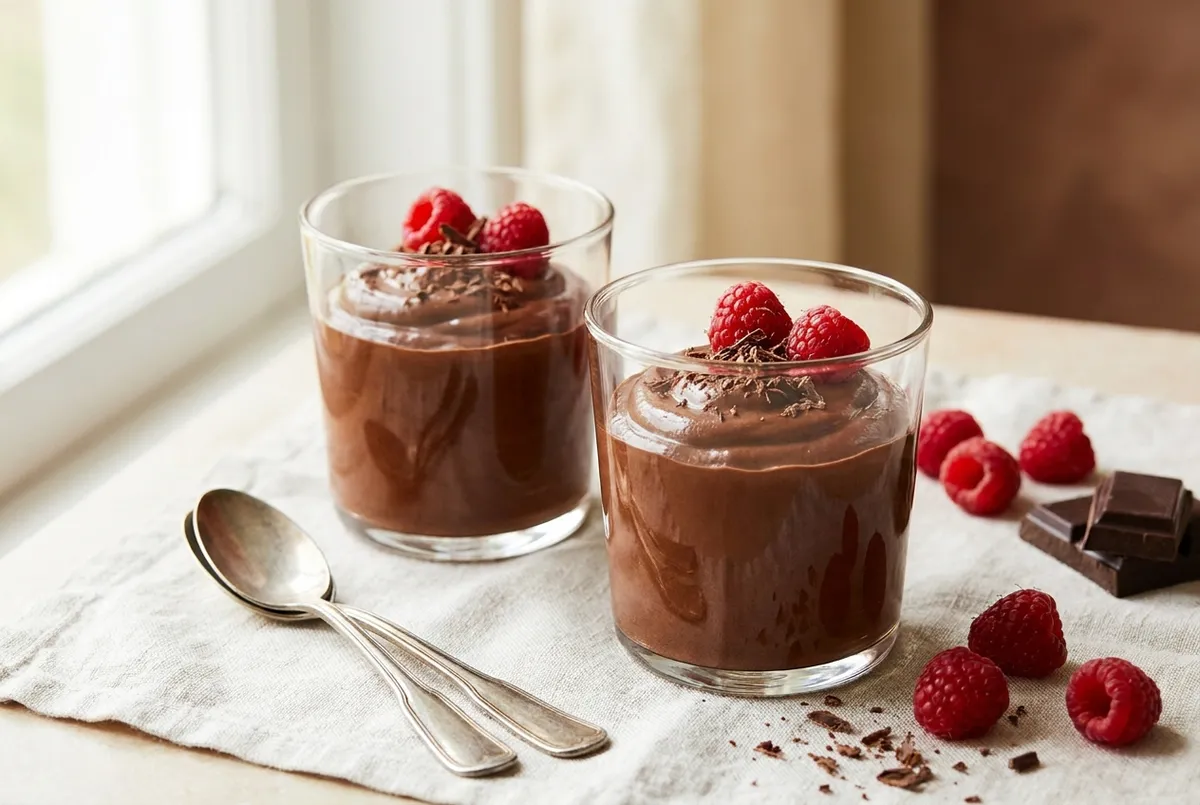
This chocolate cottage cheese mousse is a five-minute dessert that tastes rich and silky but carries 19 grams of protein per glass. Blended until glossy, the cottage cheese disappears into a deep cocoa pudding with no curds left behind. Fresh raspberries and a few shavings of dark chocolate make it feel like something from a bistro menu.
At a glance
- Protein: 19 g per serving
- Calories: 210 per serving
- Fiber: 3 g
- Calcium: 216 mg
- Total time: 5 minutes, plus optional 30 minutes chilling
- Makes: 2 servings
- Good for: No-Cook, Vegetarian, Gluten-Free, Under 30 Minutes
Why make chocolate cottage cheese mousse?
Dessert is often where good intentions go to rest. Most sweets are high in sugar and low in protein, so they spike hunger instead of settling it. This mousse flips that pattern.
A classic chocolate mousse relies on heavy cream, egg yolks, and sugar. It is delicious, but a small cup can carry well over 300 calories and very little protein. This version uses cottage cheese and Greek yogurt instead, bringing 19 grams of protein for about 210 calories.
Protein needs rise in midlife. An international expert group recommends 1.0 to 1.2 grams per kilogram of body weight daily for healthy older adults (source). An evening treat that adds 19 grams is an easy way to close the gap on days when meals fall short.
How does cottage cheese turn into mousse?
Cottage cheese is simply fresh curds in a light, creamy dressing. When blended at high speed for a full minute or two, the curds break down completely. The result is a thick, smooth cream similar in texture to ricotta or mascarpone.
Greek yogurt adds tang and body. Cocoa powder brings deep chocolate flavor without the fat and sugar of melted chocolate. A little maple syrup sweetens it, and vanilla and a pinch of salt round out the taste.
The key is blending longer than feels necessary. Stopping too early leaves tiny grains that feel gritty. Keep going until the mixture looks glossy and falls from a spoon in a thick ribbon.
Chilling for 30 minutes firms the mousse further. The cocoa absorbs moisture and the texture sets, much like a classic pudding.
Ingredients and smart swaps
The list is short and easy to find. Exact amounts are in the recipe card below.
- 2% cottage cheese: the protein base. Full-fat cottage cheese makes an even creamier mousse.
- Plain nonfat Greek yogurt: tang and thickness, plus more protein.
- Unsweetened cocoa powder: natural or Dutch-process both work. Dutch-process tastes darker and smoother.
- Maple syrup: about 1 1/2 tablespoons for two servings. Adjust to taste.
- Vanilla extract and a pinch of salt: small amounts that make chocolate taste more like chocolate.
- Raspberries and dark chocolate: optional toppings for color and a little crunch.
Swaps that keep the recipe working:
- No maple syrup? Use honey, or two soft pitted dates blended in.
- Lower sugar? Use half the maple syrup and add a few drops of liquid stevia or monk fruit to taste.
- More chocolate? Add a tablespoon of melted dark chocolate while blending for a richer, denser mousse.
- Mocha: add a teaspoon of instant espresso powder with the cocoa.
How to make chocolate cottage cheese mousse
You need a blender or food processor and about five minutes.
- Add everything to the blender: cottage cheese, Greek yogurt, cocoa, maple syrup, vanilla, and salt.
- Blend 1 to 2 minutes, stopping once or twice to scrape down the sides. Keep going until no curds remain and the mousse looks glossy.
- Taste. Add more maple syrup if you like it sweeter, and blend again for a few seconds.
- Spoon into two glasses or small jars.
- Chill 30 minutes for a firmer set, or eat right away for a softer pudding.
- Top with raspberries and a few shavings of dark chocolate.
Small blenders and immersion blenders handle this quantity well. A large blender can struggle with small amounts, so double the recipe if yours has a wide base.
Why your mousse is grainy and how to fix it
A grainy texture is the most common problem with cottage cheese desserts. It almost always means the mixture needs more blending.
| Problem | Likely cause | Fix |
|---|---|---|
| Gritty or grainy | Not blended long enough | Blend another 30 to 60 seconds |
| Too thin | Watery cottage cheese or warm ingredients | Chill 30 minutes, or add more yogurt |
| Too thick to blend | Not enough liquid | Add a teaspoon of milk at a time |
| Bitter taste | Strong cocoa or too little sweetener | Add a pinch more salt and maple syrup |
If your blender is small, blend the cottage cheese alone first until smooth, then add the other ingredients. That two-step method gives the silkiest result.
Is cottage cheese good for women over 50?
Cottage cheese is one of the most protein-dense foods in the dairy case. A half cup of 2% cottage cheese carries about 12 grams of protein for around 90 calories.
That matters for muscle and bone. Muscle mass declines with age, and the loss speeds up around menopause. Bone density also drops as estrogen falls. A consensus of bone health experts found that adequate protein, together with calcium and vitamin D, supports bone health, and that higher protein intakes do not harm bones in healthy people (source).
Each serving of this mousse also brings about 216 mg of calcium. Women over 50 need about 1,200 mg a day (source). Dairy foods are among the easiest ways to get there.
The one watch-out is sodium. Cottage cheese is salty, and this mousse carries about 411 mg per serving. If you watch your salt intake, look for low-sodium or no-salt-added cottage cheese.
How much sugar is in this dessert?
Each serving has about 17 grams of total sugar. Roughly 9 grams of that is added sugar from the maple syrup. The rest is natural milk sugar from the cottage cheese and yogurt, plus a little from the raspberries.
The American Heart Association suggests women limit added sugar to about 25 grams, or 6 teaspoons, a day (source). One serving of this mousse uses a little over a third of that. A typical bakery brownie or slice of cake can use far more.
To cut the added sugar, reduce the maple syrup to 1 tablespoon for two servings and add a ripe banana. Banana brings natural sweetness and makes the mousse even creamier.
Can you eat this mousse at night?
Yes. A small, protein-rich dessert can be a better choice than a sugary snack in the evening. Protein tends to be filling, so it may help you skip a second trip to the pantry.
Cocoa does contain a small amount of caffeine. Two tablespoons of cocoa powder split between two servings is a modest amount, far less than a cup of coffee. If you are very sensitive to caffeine, enjoy it earlier in the evening.
Many women notice that sleep becomes harder in midlife. A light dessert is unlikely to cause problems, but a large, heavy meal right before bed can make sleep less comfortable for some people.
How to store chocolate cottage cheese mousse
The mousse keeps up to 3 days in covered containers in the fridge. That makes it easy to prep a few servings for the week.
Store it in small jars with lids. Add the raspberries and chocolate shavings only when serving, since berries soften and bleed color over time.
The texture gets firmer each day, almost like a ganache. If you prefer it softer, stir in a teaspoon of milk before eating.
Freezing is possible but changes the texture. Frozen mousse turns into a dense, fudgy treat, a bit like frozen yogurt. Let it sit at room temperature for 10 minutes before eating.
Cottage cheese mousse vs classic chocolate mousse
Both desserts are rich and chocolatey. The difference is what is inside.
| Feature | Chocolate cottage cheese mousse | Classic chocolate mousse |
|---|---|---|
| Base | Cottage cheese and Greek yogurt | Heavy cream, eggs, melted chocolate |
| Protein per serving | About 19 g | Usually under 6 g |
| Raw eggs | None | Often yes |
| Time | 5 minutes | About 30 minutes plus chilling |
| Texture | Dense and silky, like pudding | Light and airy |
The classic version is airier, because whipped cream and egg whites trap air. This version is denser, closer to a pot de crème. For a lighter texture, fold in a few spoonfuls of whipped cream just before serving.
The lack of raw eggs is a real plus. Traditional mousse often uses uncooked eggs, which some people choose to avoid. This recipe has none.
Serving it for guests
This dessert is simple enough for a weeknight and pretty enough for company. A few touches make it look special.
Spoon the mousse into small glasses, espresso cups, or coupes. Small portions look elegant and feel satisfying. Chill for at least 30 minutes so the top sets smooth.
Top each glass just before serving with three or four raspberries, a few curls of dark chocolate, and a single mint leaf. A light dusting of cocoa through a fine sieve adds a bakery finish.
For a dinner party, the recipe doubles and triples easily. Make it in the morning and keep it covered in the fridge until dessert.
Topping and flavor ideas
The chocolate base pairs well with many toppings and flavors.
- Peanut butter swirl: spoon a teaspoon of warm peanut butter on top and swirl with a toothpick.
- Black forest: top with chopped cherries and a few shavings of dark chocolate.
- Orange chocolate: blend in a little orange zest and top with segments.
- Crunchy: sprinkle with chopped toasted hazelnuts or almonds.
- Mint chocolate: add a drop of peppermint extract while blending.
How this dessert fits into your day
A woman who weighs about 150 pounds and aims for 1.0 to 1.2 grams per kilogram needs roughly 68 to 82 grams of protein a day (source). One serving of mousse adds 19 grams, close to a quarter of the lower target.
Paired with the Spinach Feta Cottage Cheese Egg Bites at breakfast and the Peanut Tofu Soba Bowls at dinner, the mousse helps round out a high-protein day.
The guide on how much protein women need in menopause has a chart by body weight and a sample day of meals.
Chocolate Cottage Cheese Mousse
Ingredients
Method
- Add the cottage cheese, Greek yogurt, cocoa powder, maple syrup, vanilla, and salt to a blender or food processor.
- Blend for 1–2 minutes, scraping down the sides, until completely smooth and glossy, with no curds left.
- Taste and add more maple syrup if you like. Spoon into two glasses.
- Chill for 30 minutes for a firmer, mousse-like texture (or eat right away). Top with raspberries and chocolate shavings.
Notes
| Nutrition per serving | Amount |
|---|---|
| Calories | 210 |
| Protein | 19 g |
| Carbohydrates | 24 g |
| Fiber | 3.3 g |
| Sugars (total) | 17 g |
| Fat | 5.3 g |
| Saturated fat | 2.8 g |
| Sodium | 411 mg |
| Calcium | 216 mg |
| Potassium | 382 mg |
| Iron | 1.5 mg |
How the nutrition was calculated
Nutrition is calculated per serving from the gram weight of each ingredient, using USDA FoodData Central data. Cottage cheese brands vary in protein and sodium, so treat these numbers as estimates. See the editorial and nutrition policy for the full method.
Frequently asked questions
Can you taste the cottage cheese in this mousse?
Most people cannot. Once fully blended, cottage cheese loses its curdy texture and takes on the flavor of the cocoa. You may notice a gentle tang, similar to cheesecake. Blending long enough is the key. If you still taste it, add a little more cocoa and vanilla next time.
Can I make this mousse without a blender?
A blender or food processor gives the best result, because the curds need to break down completely. An immersion blender in a tall cup also works well. Mashing by hand will not make it smooth. Without a blender, try Greek yogurt alone with cocoa and maple syrup stirred together.
Is chocolate cottage cheese mousse keto?
Not as written. The maple syrup and natural milk sugars bring about 24 grams of carbohydrates per serving. For a lower-carb version, swap the maple syrup for a zero-sugar sweetener and skip the raspberries. That cuts the carbohydrates significantly while keeping the protein about the same.
Can I use low-fat or nonfat cottage cheese?
Yes. Nonfat cottage cheese lowers the calories but makes the mousse slightly less creamy and a little tangier. 2% cottage cheese is a good balance of creaminess and lightness. Full-fat cottage cheese gives the richest, most mousse-like texture, with a few more calories per serving.
How long does the mousse last in the fridge?
The mousse keeps up to 3 days in covered containers in the fridge. It gets thicker each day, so stir in a splash of milk if you want it softer. Keep the toppings separate until serving, since raspberries break down and turn the surface watery after a day.
Sources
- Bauer J, et al. Evidence-Based Recommendations for Optimal Dietary Protein Intake in Older People (PROT-AGE). J Am Med Dir Assoc. 2013.
- Rizzoli R, et al. Benefits and safety of dietary protein for bone health (ESCEO/IOF expert consensus). Osteoporos Int. 2018.
- NIH Office of Dietary Supplements. Calcium: Fact Sheet for Health Professionals.
- American Heart Association. Added Sugars.
- USDA Agricultural Research Service. FoodData Central (SR Legacy).
This article is for general education and is not medical advice. If you have a medical condition, such as kidney disease, or take medication, ask your clinician or a registered dietitian about your protein, sodium, and calorie needs. Read the full medical disclaimer.
Leave a Reply